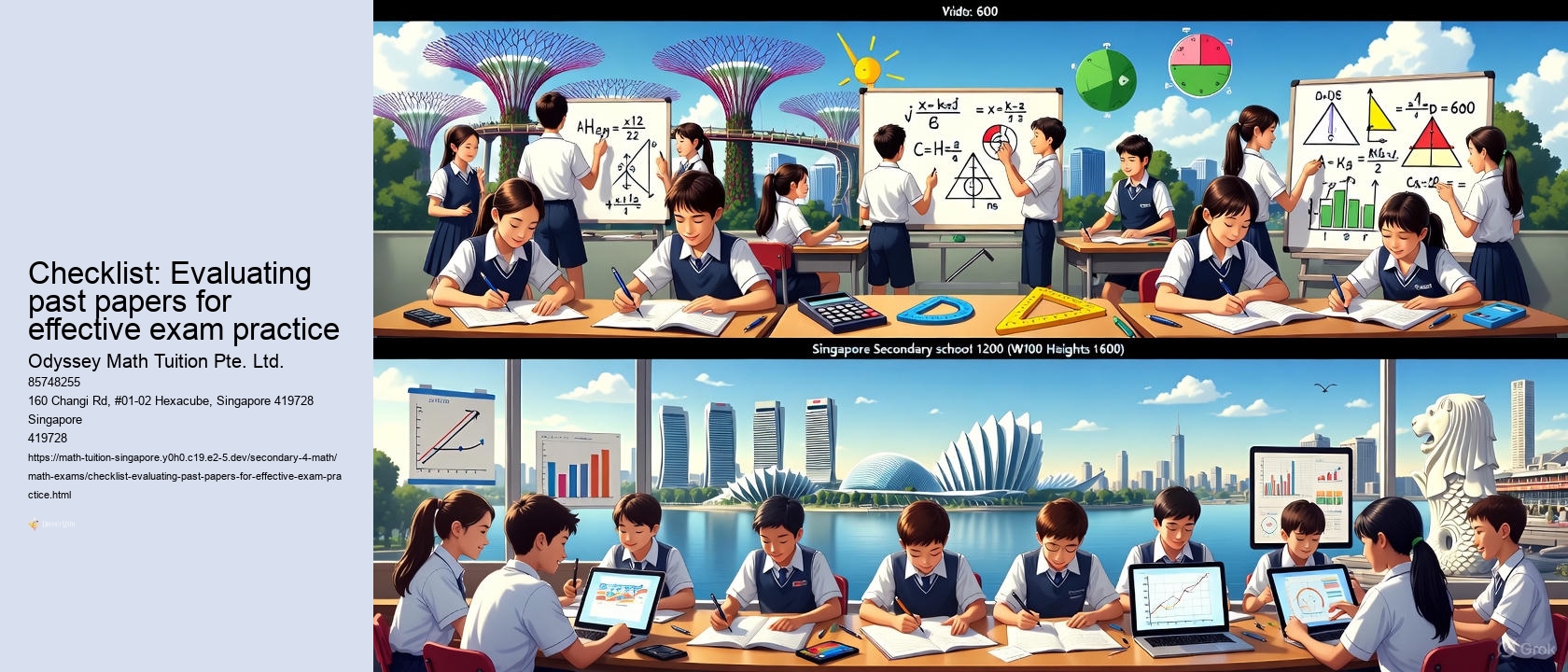
Alright, parents and Sec 4 students, listen up! In Singapore, acing your Math exams is like having a golden ticket. It opens doors to top JCs, polytechnics, and, let's be real, sets you up for a brighter future in this increasingly tech-driven world. With AI becoming more and more prevalent, a solid Math foundation is no longer just an advantage; it's practically a superpower! You want your child to "kiasu" their way to success? Then pay attention!
We all know the pressure cooker environment of Secondary 4. The 'O' Levels are looming, and everyone's "chionging" to score those precious distinctions. But here's a secret weapon that's been hiding in plain sight: Past Papers. Think of them as your personal crystal ball, giving you a sneak peek into what the examiners are likely to throw your way. They are essential resources on how to excel in Singapore Secondary 4 Math.
Fun Fact: Did you know that the Singapore education system consistently ranks among the top in the world for Mathematics? That's because we start 'em young! But seriously, all that early training pays off when it comes to tackling those 'O' Level Math problems.
So, how do you turn these past papers into your Math-conquering tool? It's not just about blindly solving them; it's about being strategic. Here’s the lowdown:
Go through a few years' worth of papers and spot the recurring themes. Are they crazy about trigonometry? Do they love throwing in tricky algebraic equations? Knowing what to expect is half the battle! This is a crucial step on how to excel in Singapore Secondary 4 Math.
Simulate exam conditions! Set a timer and see how long it takes you to complete a paper. This will help you get a feel for the pacing required during the actual exam. Nobody wants to run out of time and leave easy marks on the table, right?
In the rigorous world of Singapore's education system, parents are increasingly focused on preparing their children with the abilities required to excel in rigorous math programs, including PSLE, O-Level, and A-Level exams. Recognizing early signs of struggle in areas like algebra, geometry, or calculus can make a world of difference in building tenacity and proficiency over intricate problem-solving. Exploring dependable Singapore math tuition options can deliver customized assistance that matches with the national syllabus, ensuring students acquire the boost they require for top exam scores. By focusing on interactive sessions and regular practice, families can support their kids not only meet but go beyond academic standards, clearing the way for upcoming chances in high-stakes fields..This is where the real learning happens. Don't just brush off your errors. Figure out *why* you made them. Was it a careless mistake? Did you misunderstand the concept? Understanding your weaknesses is essential for improvement. Parents, encourage your kids to embrace mistakes as learning opportunities. This is key for how to excel in Singapore Secondary 4 Math.
Don't be shy to ask your teachers, tutors, or even your classmates for help if you're stuck on a particular question. No one expects you to be a Math genius overnight. Getting the right guidance is a smart move, not a sign of weakness. Consider getting a good Math tutor who understands the Singapore syllabus well. They can provide targeted support and help you master those tricky concepts. This is a valuable tip on how to excel in Singapore Secondary 4 Math.
Interesting Fact: The use of past papers isn't just a Singaporean thing. Students all over the world use past papers to prepare for their exams. It's a proven strategy for success!
To ensure you're getting the most out of your past paper practice, run through this checklist:
By following these tips and using past papers strategically, you'll be well on your way to acing your Secondary 4 Math exams. Remember, hard work, perseverance, and a little bit of "kiasuism" can go a long way! In Singapore's challenging education structure, parents play a essential role in leading their children through significant assessments that shape academic futures, from the Primary School Leaving Examination (PSLE) which examines basic competencies in disciplines like mathematics and science, to the GCE O-Level exams concentrating on high school mastery in diverse disciplines. As pupils advance, the GCE A-Level tests require more profound critical abilities and discipline mastery, commonly deciding tertiary entries and career directions. To remain knowledgeable on all elements of these local evaluations, parents should check out official materials on Singapore test papers offered by the Singapore Examinations and Assessment Board (SEAB). This ensures entry to the newest curricula, test schedules, enrollment information, and instructions that match with Ministry of Education criteria. Frequently checking SEAB can assist families plan efficiently, lessen uncertainties, and support their kids in attaining peak outcomes amid the demanding landscape.. Good luck, and may the Math gods be with you!
So, your kiddo is Sec 4 this year, kanchiong (anxious) already, right? We Singaporean parents, confirm plus chop (guaranteed) want the best for our children. And let's be real, acing that Secondary 4 Math exam is a HUGE deal. It's not just about the grades; it's about opening doors to future opportunities, lah! With AI becoming more and more prevalent, a strong foundation in mathematics is like having a superpower in this digital age.
Think about it: from coding to data analysis, even understanding complex financial models, math is the backbone. It's the passport to many exciting careers. So, how do we ensure our precious ones are well-prepared? It all starts with effective exam practice, and that means using past papers wisely. But aiyo, not all past papers are created equal!
Past papers are like treasure maps for exam success. They give your child a feel of the actual exam environment, the types of questions to expect, and the level of difficulty. But here’s the catch: using outdated or irrelevant past papers is like following the wrong map – you’ll end up lost!
The first thing you need to do is to check if the content in the past paper aligns with the current syllabus. In Singapore's bilingual education framework, where fluency in Chinese is vital for academic success, parents often hunt for approaches to assist their children master the lingua franca's subtleties, from word bank and comprehension to essay creation and oral skills. With exams like the PSLE and O-Levels establishing high expectations, prompt support can avert common obstacles such as subpar grammar or restricted access to traditional aspects that enhance learning. For families aiming to elevate results, exploring Singapore Chinese tuition resources provides knowledge into structured programs that sync with the MOE syllabus and nurture bilingual self-assurance. This targeted guidance not only enhances exam preparedness but also instills a deeper understanding for the language, unlocking opportunities to cultural legacy and prospective occupational edges in a multicultural community.. The Singapore Ministry of Education (MOE) updates the syllabus regularly, so topics can be added, removed, or modified. You don't want your child spending precious time on topics that are no longer tested, right?
How to check?
Besides content, the format of the exam paper also matters. Has the number of sections changed? Are there new question types, like structured questions with multiple parts, or application-based questions that require critical thinking? Familiarizing your child with the current exam format will boost their confidence and reduce anxiety on exam day.
How to check?
Fun fact: Did you know that the Singapore education system has its roots in the British colonial era? Over the years, it has evolved to become one of the most highly regarded systems in the world, constantly adapting to meet the changing needs of society.
So, how to excel in Singapore Secondary 4 Math? It's not just about rote memorization, but about understanding the underlying concepts and applying them effectively. Here are some tips:
Interesting fact: The use of calculators in Singapore Math exams has evolved over the years. While calculators are allowed for certain papers, it's crucial to understand the underlying mathematical principles and not rely solely on the calculator.
Understanding the score distribution across topics in past papers is key to exam success. This allows students to identify high-weightage areas and allocate study time accordingly. For instance, if trigonometry consistently accounts for a significant portion of the marks, it warrants more attention. Analysing score distribution helps students to strategise their revision and focus on topics that will yield the most marks, ensuring efficient use of their study time and a higher chance to excel in Singapore Secondary 4 math exams.
Ensuring that past papers align with the current syllabus is crucial for effective exam preparation. The Singapore Secondary 4 math syllabus undergoes periodic revisions, so using outdated papers can be misleading. Refer to the Singapore Examinations and Assessment Board (SEAB) website for the latest syllabus documents. Aligning past papers with the current syllabus ensures that students are practicing relevant content and not wasting time on topics that are no longer assessed, a sure way to do well in school exams.
In Singapore's demanding education environment, where English acts as the primary vehicle of education and plays a pivotal position in national exams, parents are enthusiastic to support their youngsters tackle common challenges like grammar affected by Singlish, vocabulary deficiencies, and issues in understanding or composition crafting. Establishing strong fundamental competencies from elementary stages can greatly elevate self-assurance in managing PSLE components such as scenario-based authoring and spoken expression, while upper-level pupils benefit from specific practice in book-based examination and persuasive papers for O-Levels. For those looking for efficient methods, exploring singapore math tuition agencies delivers valuable perspectives into curricula that match with the MOE syllabus and emphasize engaging education. This additional assistance not only refines exam methods through simulated trials and feedback but also encourages home routines like daily reading and discussions to nurture lifelong language mastery and educational excellence..Assessing the cognitive demand of past paper questions is vital for gauging their difficulty. Cognitive demand refers to the level of thinking required to solve a problem, ranging from simple recall to complex problem-solving. Questions that require application, analysis, and evaluation demand higher cognitive skills. By understanding the cognitive demand of different questions, students can gradually increase the complexity of their practice, building confidence and competence in tackling challenging problems. This is especially important to excel in Singapore Secondary 4 math and beyond.
Effective error analysis is a cornerstone of using past papers for exam preparation. Students should meticulously review their mistakes, identifying the underlying reasons for errors. Was it a conceptual misunderstanding, a careless calculation, or a lack of time management? By pinpointing the root causes of errors, students can take targeted steps to address their weaknesses and prevent similar mistakes in future exams. This iterative process of practice, analysis, and refinement is essential for continuous improvement and how to excel in Singapore Secondary 4 math.
Practicing past papers under timed conditions is essential for developing effective time management skills. In the Lion City's dynamic education scene, where students face significant pressure to succeed in numerical studies from early to tertiary stages, locating a tuition center that combines expertise with genuine enthusiasm can make a huge impact in cultivating a love for the discipline. Passionate educators who venture beyond repetitive learning to motivate strategic thinking and resolution competencies are uncommon, however they are crucial for assisting pupils overcome obstacles in areas like algebra, calculus, and statistics. For guardians seeking similar committed assistance, PSLE math tuition shine as a beacon of devotion, motivated by teachers who are deeply engaged in every learner's path. This unwavering enthusiasm turns into customized lesson strategies that modify to unique requirements, culminating in enhanced grades and a long-term respect for math that spans into future academic and occupational goals.. Secondary 4 math exams often require students to solve a large number of questions within a limited time frame. By simulating exam conditions, students can learn to pace themselves, allocate time to different questions based on their difficulty, and avoid spending too much time on a single problem. Mastering time management is crucial for maximising their score and achieving success in their exams, don't play play!
Confirm that the past papers align with the current Secondary 4 Math syllabus in Singapore. Discard papers with outdated topics or question formats to avoid confusion. Focus on papers that reflect the current curriculum's emphasis and assessment style.
Evaluate the variety of question types presented in the past papers. Ensure exposure to a range of problem-solving approaches, including application-based and conceptual questions. A diverse question set will prepare you for the exam's unpredictable nature.
Assess the difficulty level of the past papers relative to your current understanding. Start with papers of moderate difficulty to build confidence and identify knowledge gaps. Gradually progress to more challenging papers to simulate exam conditions.
Prioritize past papers that include detailed marking schemes or answer keys. Use these resources to understand the expected solution process and marking criteria. Analyze the marking scheme to identify areas where you can gain marks through precise and clear answers.
Alright, parents and Sec 4 students, let's talk about acing those exams, especially the dreaded Math! In Singapore, we all know "kiasu" is practically our middle name when it comes to education. But being "kiasu" doesn't mean blindly mugging everything. It means being strategic, like a general planning a battle (against the exam paper, of course!). And past papers? They are your secret weapon, your treasure map to exam success!
So, how do we use these past papers to *really* help our kids (or ourselves!) how to excel in singapore secondary 4 math? It's not just about doing them once and forgetting about it. That's like eating chicken rice without the chilli – a waste of potential!
We're going to dive deep into analyzing these papers to pinpoint those frequently tested topics. Think of it as becoming a Math detective, uncovering the exam's biggest secrets. This is crucial for focused practice and, ultimately, scoring those A1s!
Past papers aren't just about testing yourself; they're about learning the exam's language. They show you what the examiners *really* want. In Singapore's fiercely competitive academic environment, parents are dedicated to bolstering their youngsters' achievement in essential math examinations, commencing with the foundational obstacles of PSLE where problem-solving and theoretical grasp are evaluated thoroughly. As students advance to O Levels, they come across more intricate areas like positional geometry and trigonometry that require accuracy and analytical competencies, while A Levels bring in sophisticated calculus and statistics requiring profound insight and implementation. For those resolved to giving their children an educational boost, locating the tuition adapted to these syllabi can transform instructional experiences through focused approaches and professional perspectives. This effort not only boosts test performance across all stages but also instills lifelong quantitative mastery, unlocking routes to prestigious universities and STEM careers in a information-based marketplace.. It's like understanding the 'hidden curriculum' of the exam itself. And in a high-stakes environment like Singapore, that's half the battle won.
Grab a stack of past year papers (at least 3-5 years' worth) and a highlighter. Now, go through each paper question by question. Identify the topic each question belongs to (e.g., Algebra, Geometry, Trigonometry, Calculus). Create a simple table or spreadsheet. Every time a topic appears, mark it down. After analyzing all the papers, you'll start seeing patterns. Some topics will appear way more often than others. These are your key areas for focused practice. This is how to excel in singapore secondary 4 math!
Fun fact: Did you know that the Singapore education system is consistently ranked among the best in the world? This emphasis on rigorous testing and strategic learning is one of the key reasons why!
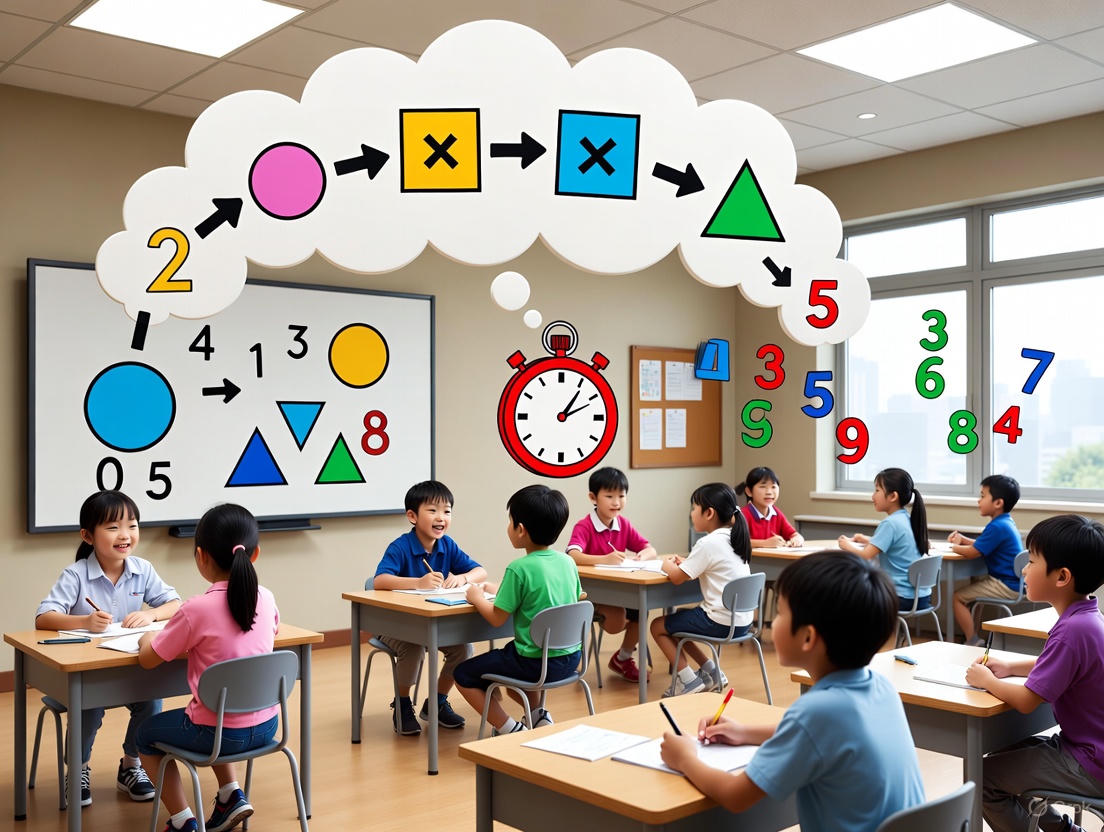
It's not enough to just identify the topics. You need to understand the underlying concepts. For each key topic, create a concept map. This visually represents the relationships between different concepts within that topic. For example, under Algebra, you might have sub-concepts like "Solving Equations," "Inequalities," and "Quadratic Equations." Seeing these connections helps you understand the bigger picture and tackle more complex problems.
Interesting fact: The first formal schools in Singapore were established in the early 19th century, laying the foundation for our current education system!
Not all questions are created equal. Some are straightforward, while others are designed to challenge even the brightest students. As you analyze the past papers, note the difficulty level of each question. Are there certain types of questions (e.g., application-based problems, proof questions) that you consistently struggle with? Identifying these weaknesses is crucial for targeted practice. Don't avoid them; attack them head-on!
History lesson, a bit relevant to Math: Did you know that the abacus, one of the earliest calculating tools, has been used in Asia for centuries? It's a testament to the enduring importance of mathematical skills!
By diligently analyzing past papers, you're not just practicing; you're learning how the exam *thinks*. You're identifying the key areas, understanding the concepts, and pinpointing your weaknesses. This is how to excel in singapore secondary 4 math, and this is how you transform from a passive student into an active, strategic learner. Now go and "chiong" those past papers! Good luck, can!
Alright, parents and Sec 4 students, listen up! In Singapore, acing those 'O' Levels is like the golden ticket, lah. And let's be real, Maths? It's the kingpin subject. Think about it – AI is taking over everything. Who do you think is building these smart machines? People who understand Maths, that's who! So, if you want your child to thrive in this new world, mastering Maths is not just important, it's essential. This is how to excel in Singapore Secondary 4 math!
But how leh? How do we conquer this Maths mountain, especially with the pressure cooker that is the 'O' Level exams? The answer, my friends, lies in the humble past paper.
Think of past papers as your secret weapon. But just having them isn't enough; you need to wield them effectively. Here's your checklist to make sure you're getting the most out of your past paper practice:
Fun Fact: Did you know that the modern concept of algebra, which forms a core part of Secondary 4 Maths, can be traced back to ancient civilizations like the Babylonians and Egyptians? They were solving equations way before we were even born!
Using past papers is more than just a practice run; it's a deep dive into the exam's DNA. It's about understanding the question types, the marking criteria, and the overall structure of the paper.
Okay, imagine this: You're in the exam hall, clock ticking, heart pounding. You see a monstrous Maths question staring back at you. What do you do? Panic? Don't! This is where time management comes in.
Here's the game plan:
Interesting Fact: Studies have shown that students who practice time management techniques consistently perform better in exams. It's not just about knowing the Maths; it's about knowing how to use your time effectively.
Past papers expose you to the different types of questions you can expect in the exam. Are there more application-based questions? More proof-based questions? Understanding the distribution helps you tailor your preparation.
Also, pay attention to the difficulty levels. Some questions are designed to be straightforward, while others are meant to challenge even the brightest students. Knowing what to expect helps you manage your stress levels during the exam.
History Lesson: The Singapore education system has evolved significantly over the years. From rote learning to a focus on critical thinking and problem-solving, the emphasis has shifted to equip students with the skills they need to thrive in a rapidly changing world. Understanding this evolution helps you appreciate the importance of adapting your learning strategies.
So there you have it! Use these tips, practice hard, and remember, jia you! You can do it!
Okay, parents, let's talk real. Your Secondary 4 child's math exams are looming, right? And in Singapore, that's like the starting gun for their future. We all know how important it is to excel in Singapore Secondary 4 math. It's not just about acing that E-Math or A-Math paper; it's about building a foundation for everything else. Think JC, poly, university… and even their future careers! With AI becoming so prevalent, the kids who understand the underlying mathematics are going to be the ones who truly thrive lah!
So, how ah? How do we make sure our kids are not just memorizing formulas, but actually understanding the concepts? One word: Past Papers. But not just doing them. We need to dissect them like a frog in Sec 3 Biology. (Remember that? *shudders*)
This section will cover the importance of answer key scrutiny and how to excel in Singapore Secondary 4 math.
Alright, here's the checklist, parents. Time to put on your "kiasu" hats (but in a productive way, okay?).
Fun Fact: Did you know that the Singapore education system consistently ranks among the top in the world for mathematics? All that hard work kena pay off one!
Okay, let's get down to the nitty-gritty. How do we actually excel in Singapore Secondary 4 Math? It's not just about mugging (cramming) until 3am, okay? It's about smart studying and understanding the underlying principles. Here are some tips:
Interesting Fact: The abacus, an ancient calculating tool, is still used in some parts of the world to teach basic arithmetic. Talk about going back to basics!
So, you've got your hands on a stack of past papers. Now what? Here's how to use them effectively:
One of the most effective strategies for using past papers is to identify recurring question patterns. By analyzing multiple past papers, students can gain insights into the types of questions that are frequently asked and the specific concepts that are consistently tested. This allows them to focus their study efforts on the most important areas and develop effective problem-solving strategies for tackling these common question types.
To maximize the benefits of past paper practice, it's essential to simulate actual exam conditions. This means setting aside a quiet space, timing yourself accurately, and avoiding any distractions. By replicating the exam environment, students can get a feel for the pressure and time constraints they'll face on the actual exam day, helping them to improve their time management skills and reduce anxiety.
History Moment: The concept of standardized testing dates back to ancient China, where civil service exams were used to select government officials. Who knew exams had such a long history?
Alright, parents and Sec 4 students, listen up! Feeling the exam stress kan cheong? We know the pressure is real. Your child's future seems to hinge on these exams, and let's be honest, in Singapore, that's not entirely wrong, lah. In this Southeast Asian hub's high-stakes education framework, where academic achievement is essential, tuition generally applies to supplementary additional lessons that offer targeted assistance in addition to institutional syllabi, assisting learners conquer subjects and gear up for major tests like PSLE, O-Levels, and A-Levels during fierce pressure. This non-public education field has developed into a thriving market, powered by guardians' commitments in personalized instruction to bridge learning shortfalls and boost performance, though it frequently increases stress on young learners. As AI appears as a disruptor, delving into advanced online tuition solutions reveals how AI-driven platforms are individualizing instructional experiences internationally, providing adaptive coaching that outperforms standard methods in productivity and engagement while tackling international learning inequalities. In the city-state in particular, AI is disrupting the traditional private tutoring model by allowing budget-friendly , on-demand applications that correspond with local curricula, possibly lowering fees for families and improving results through insightful insights, although ethical issues like heavy reliance on digital tools are examined.. Especially when it comes to maths. Think about it: AI is taking over, right? The foundation of AI? Maths! So, how to excel in Singapore Secondary 4 math isn't just about acing that A-Math paper; it's about equipping your child for a future where mathematical thinking is king.
But how ah? Don't worry, we've got some tips for you to help your child navigate the treacherous waters of Secondary 4 math and emerge victorious! One crucial strategy? Mastering past papers.
Past papers aren't just a stack of old questions; they're a treasure trove of insights into what the examiners love to test. They're like a secret decoder ring to understanding the exam's DNA. Using past papers strategically is key to exam success. Here's how:
This is where the "pattern recognition" comes in. Don't just solve the questions; analyse them. Is there a particular type of trigonometry question that keeps popping up? Are they obsessed with quadratic equations disguised as word problems? Spotting these recurring themes is half the battle won.
Fun Fact: Did you know that the Singapore-Cambridge GCE O-Level examinations have been around for decades? Looking at papers from even 10 years ago can still reveal valuable insights into the core concepts being tested! It's all about understanding the fundamentals, you see!
Once you've identified the recurring question types, it's time to develop specific strategies to tackle them. This means:
Interesting Fact: Many top students in Singapore swear by the "blurting" method. After reviewing a chapter, they try to write down everything they remember from memory. This helps identify knowledge gaps that need to be addressed before tackling past papers.
Remember, lah, how to excel in Singapore Secondary 4 math isn't just about memorizing formulas; it's about understanding the underlying concepts and developing the problem-solving skills to apply them effectively. And past papers are your best weapon in this battle for exam success. So, jia you! (Add oil!) You can do it!